
Boost Leadership Credibility and Influence with These Four Executive Presence Skills
Ever wonder why some leaders effortlessly command a room while others struggle to be heard? The difference lies in executive presence and influence. Far from being a natural-born trait, executive presence is a career-defining skill set that any leader can cultivate. If you are ready to boost your leadership credibility, drive organizational trust, and deliver better business results, focusing on these four core leadership behaviors will transform how you show up, decide, and inspire.
“She’s a born leader.”
“She has that ‘IT’ Factor.”
“He can really command a room.”
We’ve all heard these comments or similar ones, and we can all picture exactly the kind of leaders these sentences describe—impeccably dressed, authoritative, charismatic leaders who walk into a room and hold everyone’s attention without any obvious effort.
What makes these leaders so compelling? Why do people seem willing to fall in line behind them, no matter which direction they’re walking?
In the past, we might have called it charisma, drive, or gravitas.
Today, we call it Executive Presence and Influence.
What is Executive Presence?
Executive presence is often equated with the ability to dress well, deliver a strong presentation, or speak with confidence. The concept might recall the stereotypical 20th Century businessman in a power suit and tie, ala Gordon Gecko from Wall Street or Don Draper from Mad Men.
But a modern understanding of executive presence encompasses more than just appearance or speaking ability. Executive presence is something any leader can develop to guide the impact they have on others.
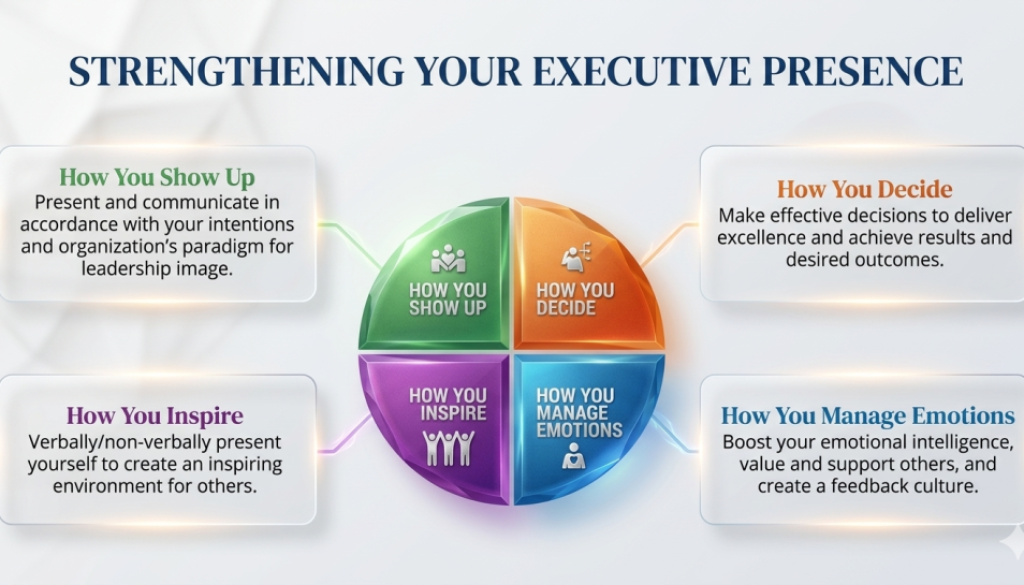
There are four key areas that shape how others react to the leaders around them:
- How they show up in interactions
- How they make decisions
- How they manage their emotions
- How they inspire others
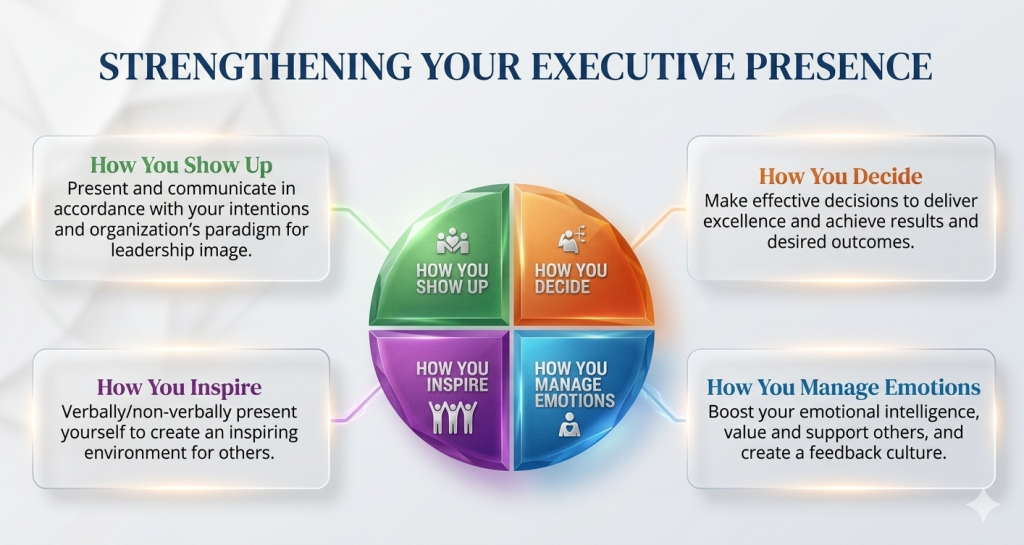
Within each of these areas is a set of behaviors that, when well-developed and honed, can lend sales and marketing leaders the kind of confidence and credibility that drives influence, engenders trust, and delivers results for customers, team members, colleagues, and bosses.
To start improving your own executive presence and influence right now, focus on these four key behaviors.
Craft Your Brand
What works for goods and services can also work for leaders. As Jeff Bezos has said, “Your brand is what people say about you when you’re not in the room.”
At its core, a leadership brand is a set of characteristics and qualities that set a leader apart as distinct or unique. To build a leadership brand, start with the following questions:
- What do I want to be known for?
- What do I want to accomplish as a leader (both short- and long-term)?
- How do I want to deliver results?
By crafting a brand that’s aligned with intentions, leaders can influence what others say about them when they’re not around as they deliver the desired results.
Employ the “Pause”
Effective decision-making is a key component of good executive presence and influence. When leaders understand how to manage time and priorities, define problems, and make effective decisions that deliver excellence, they can build trust, credibility, and authority with colleagues, team members, and customers.
But one often underrated habit that can provide big dividends is the pause. Practice pausing in the course of a decision-making process to check for biases or evaluate new perspectives that might help produce better results.
Pausing offers space to consider:
- What information might be missing
- Who might be unintentionally affected
- How to address challenges or unforeseen obstacles
- What additional resources might be necessary
- What biases might be affecting my decision making
In rapidly changing environments and circumstances, a lot of emphasis is placed on quick reactions and decisions. Employing the “pause” can be a differentiator that shows thoughtfulness and builds trust.
Practice Reframing
One of the toughest skills to develop is the ability to manage emotions, especially in the middle of challenging or stressful situations. But managing emotions is essential to developing good executive presence and influence. Leaders who maintain a level of self-regulation under pressure communicate thoughtfulness, comfort with ambiguity, and integrity, which all build trust and confidence with others.
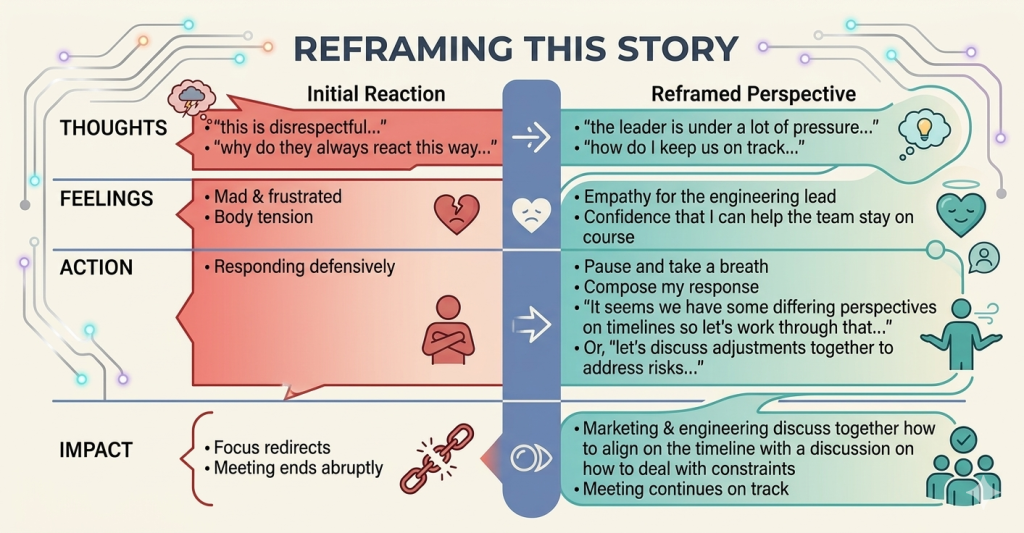
A useful practice to help develop greater ability to regulate emotions is reframing. When humans encounter a high-stakes emotional trigger, it’s common for them to respond as if they are under a direct attack. Human brains still have the same instincts that kept them safe from predators on the savannah, and they can easily interpret normal business friction as a personal attack.
A better approach to things like criticism, tough feedback, or competing interests is to intentionally interrupt that threat response and reframe the situation. Take a moment, consider how the other parties view the situation, and compose a measured, strategic response before speaking. Shifting from the instinctive question “who’s at fault?” to a more productive “what’s the problem we need to solve?” can shift your brain from instinct to higher functioning and help project a sense of authority, while simultaneously redirecting the conversation in a positive direction.
Build Relationships
At the heart of every leadership role are relationships. These relationships are more than just lines on an org chart or informal connections in the hallway. They are key to creating a vision, sharing common purpose, and building influence for long-term results.
Leaders should take some time to map key relationships in each of four key categories: bosses, peers, customers, and direct reports. For each person, the leader should identify:
- What that person values
- How that person perceives the leader
- Frequency of interaction with that person
- Any changes that might be necessary in that relationship
Is there one relationship that needs to be repaired? Or one that could benefit from some casual conversation over lunch?
Leaders who take the time to build strong relationships across both formal and informal lines will see their influence across the organization grow over time.
Strong executive presence isn’t something leaders can perfect overnight. However, by focusing on individual behaviors one at a time, any leader can learn to show up, decide, manage emotions, and inspire in ways that deliver business results—and people results!
Want to learn more about how to develop executive presence?
Check out our on-demand webinar “How to Develop Executive Presence to Build Credibility and Influence” led by Daniel Stewart.