
Marketing Attribution Models Explained: Choosing the Right Approach
A practical guide to marketing attribution, pipeline attribution, and revenue attribution—including first touch vs last touch attribution, multi-touch attribution, and real attribution model examples you can report with confidence.
What are Attribution Models?
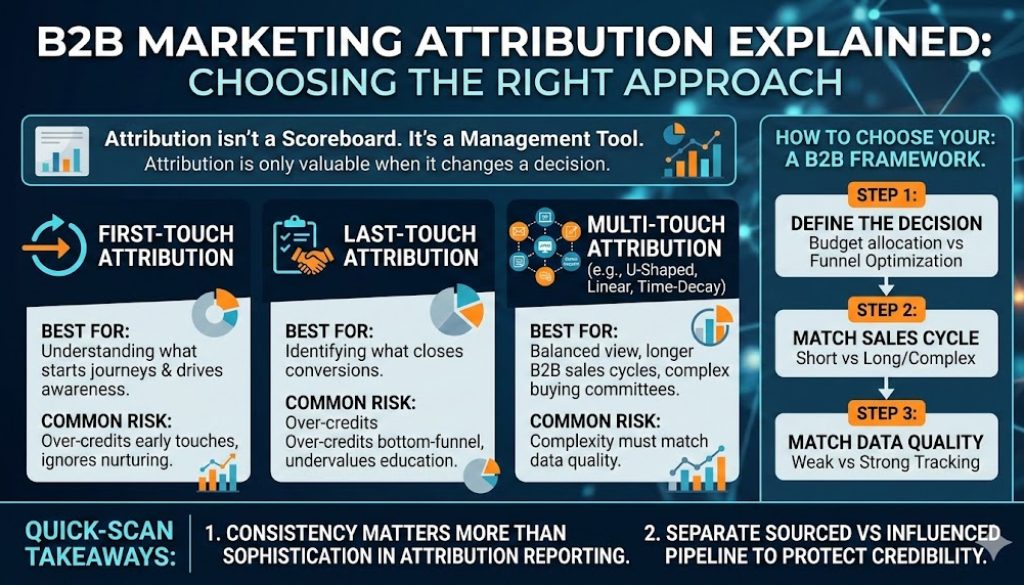
Marketing attribution models are methods for assigning conversion credit across the touchpoints that happen before a lead becomes pipeline or revenue. The best attribution model is not the most complex one. It’s the model that matches your sales cycle, data quality, and the decision you need to make. Marketing attribution is most useful when it helps you do one of three things: shift budget, improve funnel conversion, or prove marketing’s contribution to pipeline in a way leadership trusts. Most executives don’t reject attribution because they hate marketing, they reject attribution because the story changes every month. This guide explains the core marketing attribution models, what each one is good for, what each one can mislead you into believing, and a practical framework for attribution reporting that stays credible.
Quick-Scan Takeaways
- Attribution models don’t reveal “truth.” They apply assumptions to your data.
- Use different models for different questions (awareness vs conversion vs pipeline contribution).
- Consistency matters more than sophistication in attribution reporting.
- Separate sourced vs influenced pipeline to protect credibility.
- A good attribution report ends with a decision, not just a chart.
What an Attribution Model Actually Is
An attribution model is a rule set (or algorithm) that determines how credit is distributed across a buyer journey.
Attribution is only valuable when it changes a decision, such as where you allocate budget or what you stop doing.
The Core Marketing Attribution Models (and what they’re best for)
- First-Touch Attribution (First Click)
What it does: 100% of credit goes to the first meaningful touchpoint.
Best for: understanding what starts journeys and drives awareness.
Common risk: it over-credits early touches and ignores nurturing.
This is the model people mean when they ask: “What created demand?” - Last-Touch Attribution (Last Click)
What it does: 100% of credit goes to the final touchpoint before conversion.
Best for: identifying what closes conversions.
Common risk: it over-credits bottom-funnel touches and undervalues education.
This is often the model behind “What drove the demo request?” - Linear Attribution
What it does: credit is distributed evenly across touchpoints.
Best for: establishing a baseline when you want a balanced model.
Common risk: it can over-credit low-impact touches and under-credit the moments that truly shifted intent. - Time-Decay Attribution
What it does: touches closer to conversion get more credit.
Best for: longer cycles where recent activity indicates intent.
Common risk: it under-credits early education that created trust and category understanding. - Position-Based Attribution (U-Shaped)
What it does: heavy credit to first and last touch, with remaining credit split across the middle.
Best for: journeys where discovery and conversion moments are most meaningful.
Common risk: the weighting reflects belief, not proof. - Data-Driven / Algorithmic Attribution
What it does: credit is assigned based on patterns observed in your data.
Best for: organizations with high conversion volume and clean tracking.
Common risk: harder to explain; teams may treat it as truth instead of a model.
The best attribution model is the one your organization can apply consistently and trust enough to act on.
Attribution Model Examples (Why Models Disagree)
Imagine a B2B journey:
- Search → educational blog post (first touch)
- Webinar signup
- Retargeting click
- Demo request (last touch)
- First touch attribution credits the blog post
- Last touch attribution credits the demo request source
- Linear spreads credit across all touches
- Time-decay emphasizes the retargeting + demo request
None of these are “wrong.” They answer different questions.
Attribution models disagree because they were designed to answer different questions about the same journey.
Reality Check: Pipeline Attribution Matters More Than Click Attribution
The real argument isn’t clicks. It’s pipeline.
A practical way to maintain credibility is to report in two layers:
- Sourced pipeline (high confidence): pipeline created from marketing-sourced leads or first-touch origin rules
- Influenced pipeline (directional but useful): pipeline where marketing touched and improved progression, but did not create first origin
This is the cleanest way to talk about pipeline attribution without pretending every touch “caused” revenue.
Credibility improves when you label certainty explicitly instead of presenting influence as revenue proof.
How to Choose the Right Model
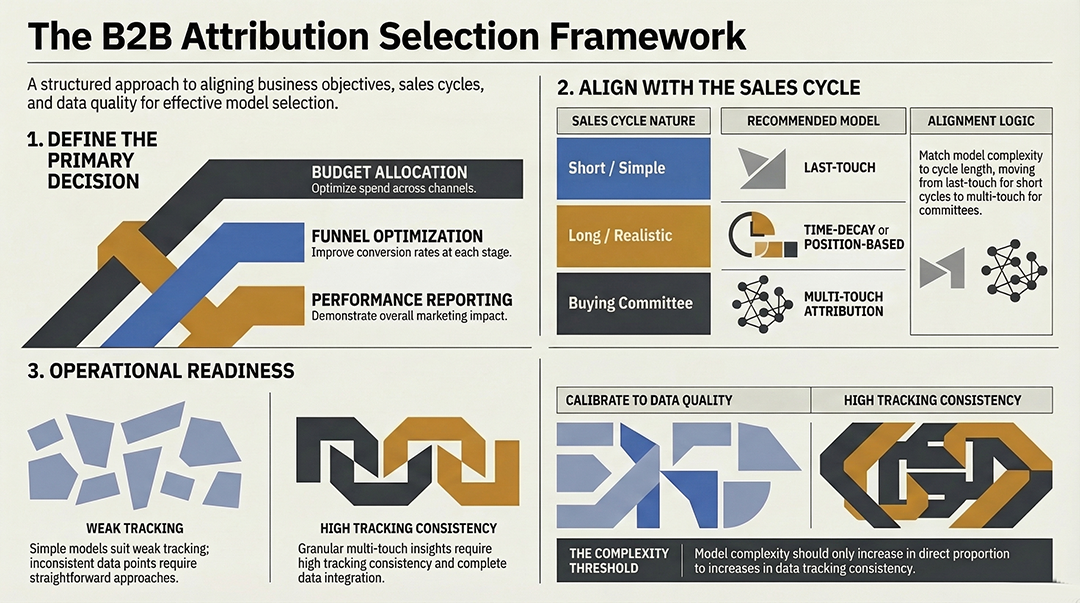
Step 1 — Define the decision you are trying to make
Pick one primary decision:
- Budget allocation (channels)
- Funnel optimization (where leads drop off)
- Performance reporting (what leadership needs to see)
If you can’t name the decision, you can’t choose the model.
Step 2 — Match the model to your sales cycle
- Short cycle → last-touch can be directionally useful
- Long cycle → time-decay or position-based is often more realistic
- Complex buying committee → multi-touch attribution is usually required
Step 3 — Match the model to your data quality
- Weak tracking → simpler model + conservative reporting
- Strong tracking → multi-touch + more granular insights
- Mixed tracking → use a baseline model and upgrade later
Model complexity should increase only when tracking consistency increases.
The Most Common Attribution Mistakes
- Switching attribution models month to month (kills comparability)
- Changing definitions quietly (what counts as a touchpoint, what counts as conversion)
- Treating one model as “truth” instead of “a lens”
- Reporting a chart without a decision outcome
- Overclaiming ROI when the tracking chain is incomplete
FAQ
Which attribution model should teams start with?
Start with a baseline model your org understands and can apply consistently. Then improve tracking and only then move into more complex models.
Should we use one attribution model for everything?
No. Use the model that matches the decision you’re making. Different models answer different questions.
How do we avoid attribution fights internally?
Standardize definitions, document assumptions, and separate sourced pipeline from influenced pipeline in your attribution reporting.
Download our Marketing Attribution Blueprint
A diagnotic playbook for shifting budget, improving conversion, and improving pipeline contribution.